Limestone Below Ground Stops Site Work Cold
Rock removal in Austin for properties where buried limestone and caliche deposits block grading, foundation prep, or drainage work
Central Texas sits on a limestone shelf that shows up uninvited on job sites—sometimes as surface outcroppings, sometimes as caliche hardpan a few inches below grade. Cut It Out Land Management handles rock removal in Austin for homeowners and builders who hit stone during clearing, grading, or excavation and can't move the project forward until it's out. The Hill Country substrate doesn't care about your construction schedule, and caliche that locks up a skid steer bucket mid-pass stops the whole operation cold.
Rock removal in Central Texas typically requires a hydraulic breaker attachment mounted to the skid steer—the same equipment already on site for clearing and grading. Breaking limestone in place, loading the material, and either hauling it out or spreading it as fill are all part of the process. The right approach depends on rock depth, surface coverage, and what the cleared area will be used for—a foundation pad has different tolerances than a gravel access road.
Request an on-site look to assess rock depth and surface coverage before settling on a scope of work.
What Proper Rock Removal Actually Requires
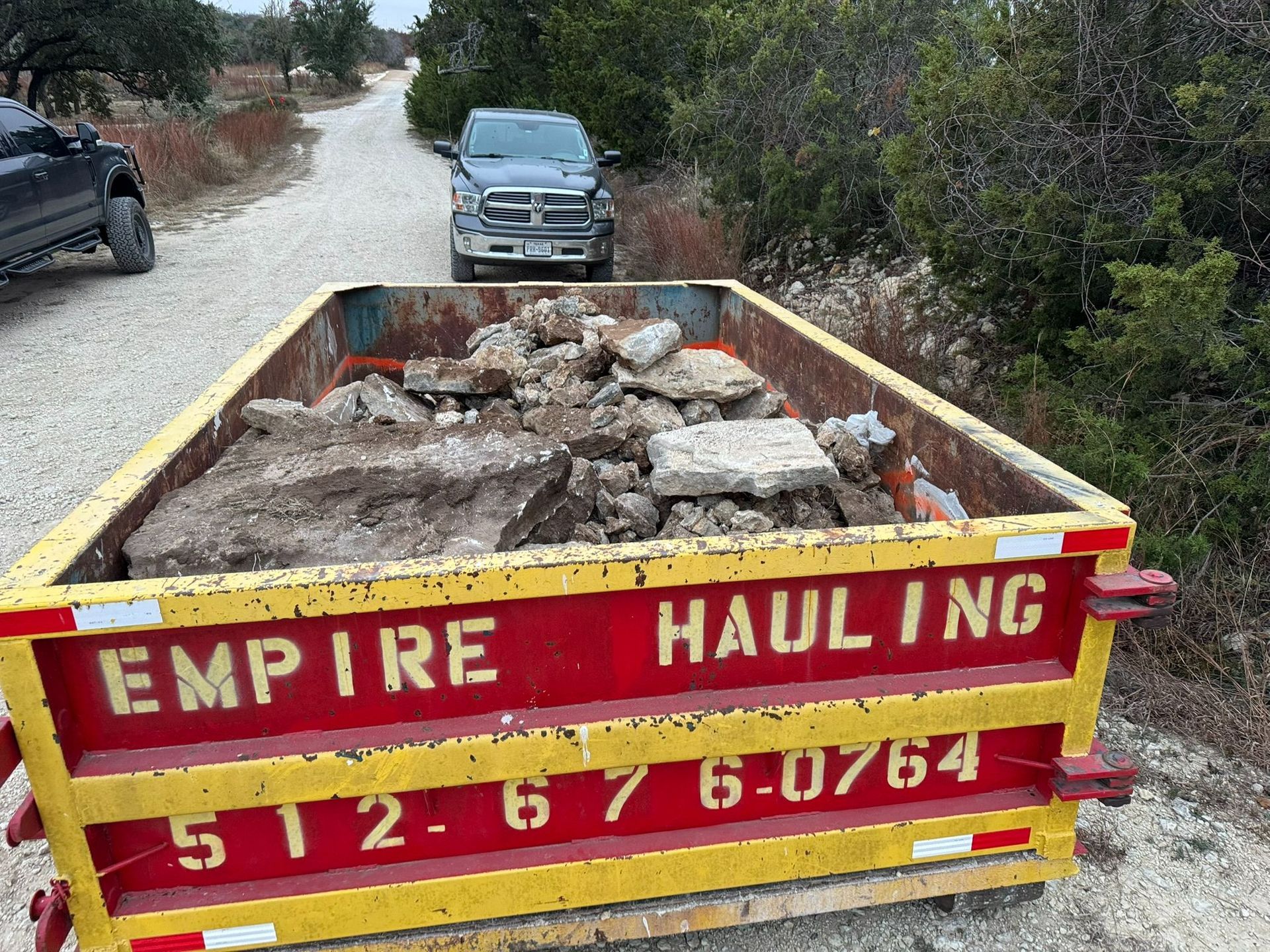
Breaking rock is one step—moving it is another. Limestone slabs and caliche chunks don't disappear once they're broken; they have to go somewhere. The skid steer loads broken material into haul piles or repositions it as fill for low spots on the same property if the material is clean enough. Deciding whether to haul off or repurpose depends on piece size, soil contamination, and what the site needs next.
Once rock is out, the difference shows up immediately: the skid steer bucket moves through the cleared area without stopping, grading runs straight, and drainage slopes function the way they're supposed to. Properties that were graded poorly or left partially cleared often have buried rock contributing to drainage problems—water pools above impermeable limestone rather than moving off the site.
Cut It Out Land Management typically pairs rock removal with grading or land clearing on the same mobilization, which keeps costs from stacking across multiple trips. What's included versus what's separate—like disposal fees for hauled material—gets spelled out in the estimate before work starts.
Questions Property Owners Ask About Rock Removal
Rock questions come up on almost every job in this part of Texas because limestone and caliche are everywhere and they don't always show themselves until equipment is already on site.
What equipment handles rock removal on a residential lot?
A hydraulic breaker mounted to a skid steer breaks surface and shallow subsurface limestone without requiring excavation equipment sized for commercial sites—the compact footprint matters on tight residential lots.
How deep does rock typically run in the Austin area?
Depth varies across the region, but caliche hardpan can appear just a few inches below grade while solid limestone shelves run deeper in hill country parcels—a site walk narrows that down before work begins.
What happens to the rock once it's broken?
Broken material either gets loaded and hauled off-site or redistributed as fill, depending on piece size and what the site needs—clean caliche and crushed limestone both work as base material under gravel.
When does rock removal fit into the overall land prep sequence?
Rock removal typically happens after initial clearing and before final grading so the blade isn't fighting buried stone during finish grade work.
Why does caliche cause more problems than visible surface rock in some cases?
Caliche is a cemented soil layer that behaves like rock but doesn't always look like it from the surface—equipment hits resistance mid-pass, which slows grading and can be misread as soft soil until the layer is broken and cleared.
Before any equipment rolls, Cut It Out Land Management walks the property to confirm what's actually there and what the work will involve—set up a free on-site estimate to get a straight answer on what rock removal will take on your site.